
Tempting as it may seem, jacking up the listing price of your home to leave room for negotiations is a dangerous risk that a lot of sellers regret taking.If you are really serious about selling…
Tempting as it may seem, jacking up the listing price of your home to leave room for negotiations is a dangerous risk that a lot of sellers regret taking.If you are really serious about selling your home, it is best to take pricing seriously by listing your home at its fair market value. Otherwise, you may end up sabotaging your chances on a good deal.
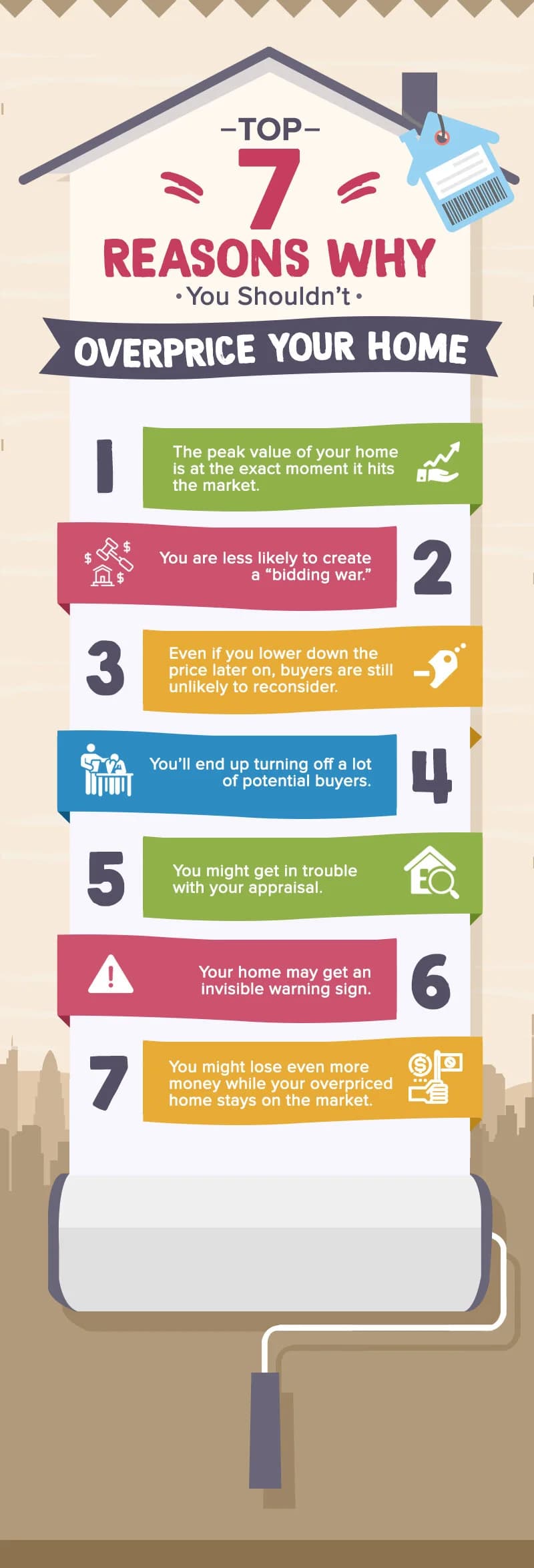
Here are the top 6 reasons why you shouldn't be in the business of overpricing your home:

1. The peak value of your home is at the exact moment it hits the market.
The first two weeks after your house is listed on the MLS are the most important, since this is when your home is going to generate a lot of activity. If you price your home too high, many buyers will overlook it since it would instantly be out of their range. With no offers on the table, your property will stay on the market for too long--leaving the next batch of buyers worried that something may be wrong with it.
You may also want to be wary of inexperienced listing agents who promise an unrealistically high asking price for your home. Experienced and trustworthy agents know that this is an unethical practice that will cost the seller a lot of time and money, since the home will eventually need a price drop after sitting on the market unnoticed for way too long.
When your house loses its “freshness” without seeing any offers, its value will drop even lower than the price you should have given it in the first place.
2. You are less likely to create a “bidding war.”
A competitively priced home will attract a lot of potential buyers, and is most likely to receive multiple offers in its first two weeks. This creates a bidding war that ultimately drives up the value of your home. On the other hand, an overpriced home won't generate a lot of competition. Worse, it may not get any offers!
3. Even if you lower the price later on, buyers are still unlikely to reconsider.
In this market, most buyers won’t wait around for a house that they’ve already marked as out of their price range. Once they cross you out of their list, buyers will immediately move on to look at other houses they can actually afford.
In the event that a buyer really falls in love with your house, he or she will most likely wait for it to sit on the market long enough for you to accept a lowball offer. However, it is unlikely for them to make any kind of offer while your house still has that unreasonably hefty price tag. Also, a lot of buyers may have already found another house by the time you reduce your price to fair market value.
4. You’ll end up turning off a lot of potential buyers.
In this market, almost no one can pull off selling an overpriced home. Today’s buyers have 24/7 access to information via the internet, and are highly aware of market values. More often than not, they know when a house is grossly overpriced, and it reflects poorly on you (the seller) no matter what.
Even if the decision to list the home at such a high price is simply a miscalculation due to a lack of experience and research (and not because the seller is actually trying to get away with selling at the highest price possible), buyers wouldn’t want to deal with a seller who isn’t responsible enough to come up with a fair market price.
5. You might get in trouble with your appraisal.
If you do get that higher offer for your home, chances are the offer will be contingent on appraisal. If you priced it way beyond its appraised value based on comps in your area, you could get yourself into an appraisal problem. When this happens, you may be forced to lower down your price anyway or lose the deal altogether.
6. Your home may get an invisible warning sign.
If your home sits on the market for too long, neighbors and potential buyers will assume that there is a problem with it. The home will be stigmatized, and buyers will either be too turned off or too afraid to check it out.
No one wants to buy a house that nobody else seems to want. A house that sticks on the market for months often generate suspicions that some undisclosed feature or element is making it unsalable.
7. You might lose even more money while your overpriced home stays on the market.
By continuing to pay for the monthly expenses of your home while the selling period stretches on, any profit you may get from selling it at a higher price could simply offset your Principal, Interest, Taxes, and Insurance (PITI) expenses. If you’ve already moved, you might even have to pay for two mortgages for a long time, or maintain the property through another season.
Related Articles
The Haunted Listing: Why Overpricing Your Home is A Terrifying Mistake
Like any promising tale, your home sale journey starts with great potential: a beautiful property that's been carefully prepared, the nooks and crannies have been cleaned, and the listing photos…
Here's Why Having A Good Driveway Matters When Selling Your Home
When it comes to curb appeal, homeowners often overlook the condition and appearance of their driveway. They think mostly of their front door color, mailbox, fence, landscaping, or outdoor living…
Easy and Inexpensive Bathroom Updates You Can Make Before Selling Your Home
As with the kitchen, the bathroom plays a huge role in making a good impression on home buyers. They love the allure of a fresh and relaxing space where they can envision themselves enjoying a…